

EN
REGARDS
The Gaze in Contemporary Figurative Painting
Human Posture, Spatial Construction and Structured Gaze
Contemporary figurative painting questions human presence within space. It observes the body, its posture, its tension, its silence. In Alain Rouschmeyer’s work, the gaze becomes a tool of construction. Each figurative painting is organized around a precise dialogue between figure and architecture. Space is not a backdrop. It structures the scene. It guides the light. It directs the viewer’s reading.
Trained in architecture and drawing, Alain Rouschmeyer develops a contemporary figurative painting grounded in composition and control of the frame. The sketch precedes the canvas. It defines intention. It clarifies the relationship between the body and its environment.
Through this research, contemporary figurative painting regains its analytical power. It situates human posture within a place. It reveals presence. It invites a slow reading. Here, the gaze constructs meaning.
The Gaze as Structure
The gaze organizes the composition. It determines axis, rhythm and distance. In Alain Rouschmeyer’s contemporary figurative painting, nothing is accidental. Each figure is positioned within a precise architectural framework. The frame builds visual tension. Human posture relies on invisible lines.
The sketch plays a central role. It allows spatial analysis before color intervenes. It clarifies the relationship between the body and its environment. This stage gives contemporary figurative painting a solid foundation. The figure does not drift. It inhabits a defined place.
Architecture directly influences composition. Vertical lines stabilize. Horizontal lines open the space. Planes guide the viewer’s gaze. This constant dialogue between drawing and structure reinforces the coherence of each contemporary figurative artwork.
The gaze does not merely observe. It constructs. It organizes. It reveals the tension between human presence and architectural space.

Human Posture Within Space
Human posture forms the point of balance in Alain Rouschmeyer’s contemporary figurative painting. The body does not merely occupy a place. It engages in dialogue with it. Each inclination, each support, each tension creates a direct relationship with the surrounding architecture.
Space structures the figure. Vertical lines stabilize presence. Horizontal planes create breathing room. The distance between the body and the wall, between the figure and the opening, determines how the contemporary figurative painting is read. Posture becomes a vector of meaning.
This attention to bodily position originates in drawing. The sketch analyzes the distribution of masses. It clarifies anchoring points. It defines the relationship between interior and exterior space. Contemporary figurative painting here does not pursue immediate effect. It builds a presence rooted in place.
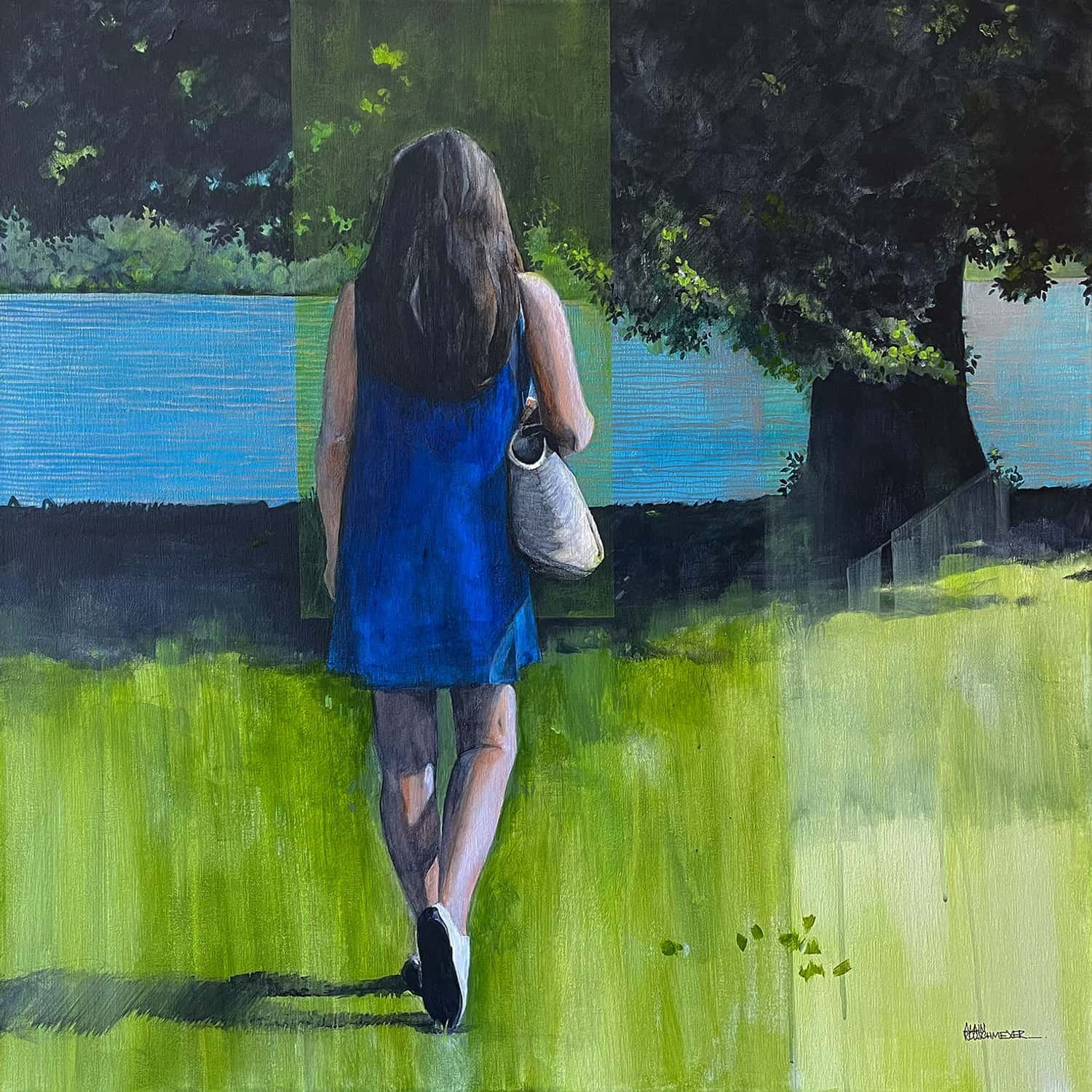
In works such as La Fille en Bleu, human posture reveals spatial structure. The body acts as a reference point. It measures the room. It exposes depth. The scene becomes a study of presence.

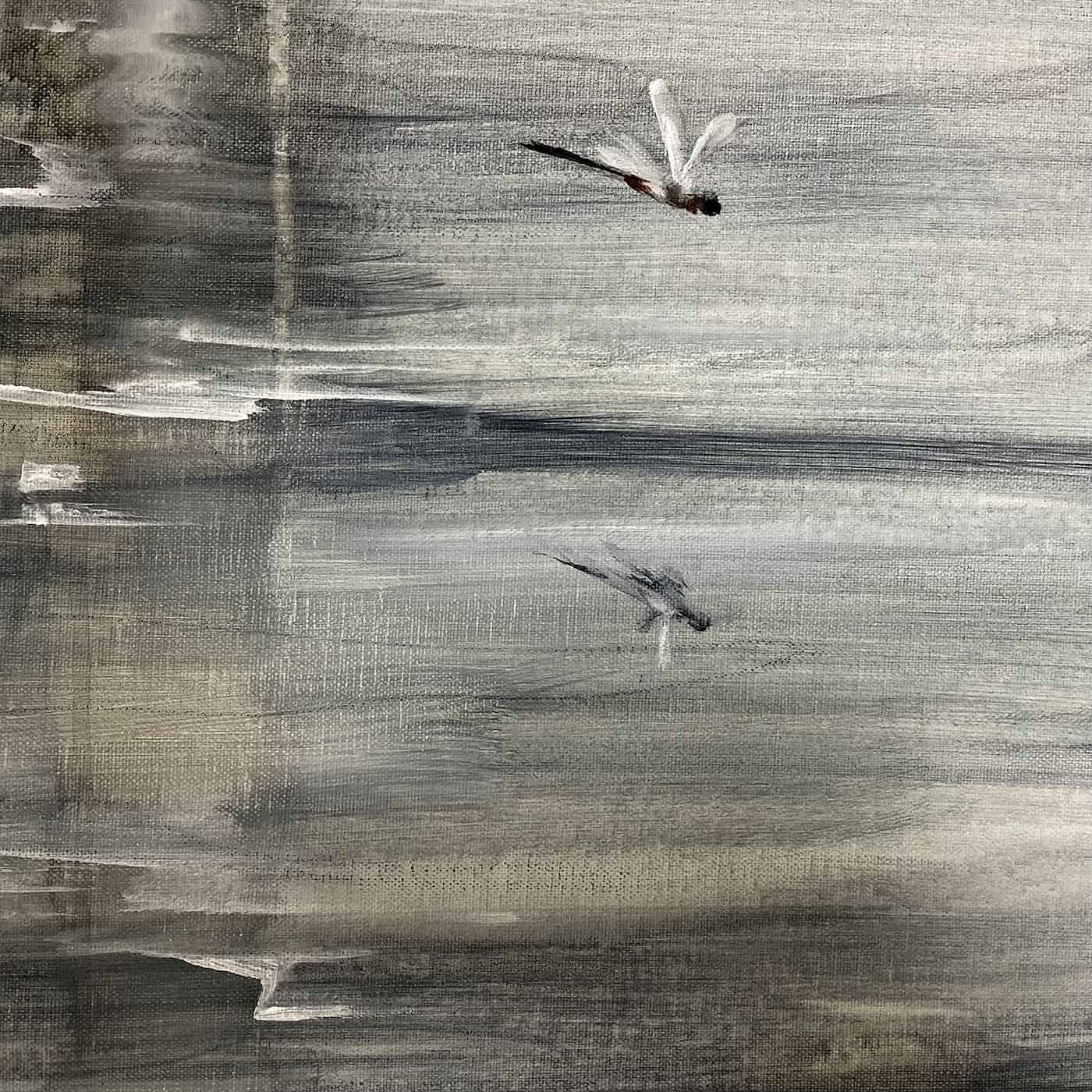
In the splashing freshness of a waterfall, a woman steps forward, smiling, guided by the delicate dance of a dragonfly.
Under the shimmering light, the water becomes a moving script, and every gesture is written with pure vitality.
Technical details
Technique: Acrylic on canvas
Dimensions: 100 x 100 cm
Year: 2024
Support: Canvas on wooden stretcher bars
Framing: unframed
Finish: Satin anti-UV varnish
Certificate: Original signed artwork, delivered with certificate of authenticity
Artistic approach
"LA CASCADE" captures a moment of vivid energy and a subtle connection between humans and the flowing elements of nature.
The discreet presence of the dragonfly accompanies this aquatic journey, acting as a fragile and free companion.
This painting celebrates the tender courage of surrendering to the flow, the moment, and the simplicity of being.
Make an offer
Interested in acquiring this piece?
Click here to make an offer
Each painting finds its place, each encounter its rhythm.
Reproduction available
This artwork is also available as a fine art print (on canvas, paper, aluminium…)
to be informed of the possibilities
Price
Secure payment – Free shipping within France – Careful packaging
Directly from the artist’s studio – Leasing available on request
Shipping & returns
Shipping within 7 to 10 business days
Returns accepted within 14 days (see conditions)
The artwork is insured during transit
Legal notices
Architecture and Spatial Construction
Architecture forms a structural foundation in Alain Rouschmeyer’s contemporary figurative painting. It is not ornamental. It organizes the framework. It defines axes. It imposes compositional rigor.
Training in architecture informs this approach. The plan precedes volume. The line precedes color. Each contemporary figurative painting rests on a precise construction. Space becomes an active element. It conditions human posture and directs the gaze.
Drawing plays a decisive role. It allows analysis of depth. It establishes scale relationships. It defines tensions between vertical and horizontal lines. This method gives contemporary figurative painting a strong spatial coherence.
Within this framework, space is not a backdrop. It acts as a structure. It measures presence. It reveals the density of the body within a defined place. The human figure operates within a constructive logic. It engages with the geometry of the frame.

She is seated there, in the hazy morning light.
The silence is not empty — it is filled with reflections, with memories quietly awakening.
She does not look at the lake — she breathes it in, listens to it, as one listens to an absence or a promise.
Official Valuation
This artwork benefits from two recognized professional valuations:
View both official valuations
i-CAC: Valuation listed on the official platform for registered professional artists.
Judicial Expert (Pierre Gimenez): Certified appraisal used in legal, tax, and estate contexts.
Technical details
Technique: Acrylic on canvas
Dimensions: 120 × 120 cm
Year: 2023
Support: Canvas on wooden stretcher bars
Framing: no frame
Finish: Satin anti-UV varnish
Certificate: Original signed artwork, delivered with certificate of authenticity
Artistic approach
This painting is part of a series of contemplative works in which the female body becomes presence in the world.
It is less about representing and more about allowing what is felt to appear — a posture, a threshold, a suspended moment between intimacy and landscape.
The lake, calm and reflective, becomes the interior space of the figure.
Make an offer
Interested in acquiring this piece?
Click here to make an offer
Each painting finds its place, each encounter its rhythm.
Price
Secure payment – Free shipping within France – Careful packaging
Directly from the artist’s studio – Leasing available on request
Shipping & returns
Shipping within 7 to 10 business days
Returns accepted within 14 days (see conditions)
The artwork is insured during transit
Legal notices

A suspended moment, on the edge of deep green waters.
Her back, open to the air and the light, becomes the anchor of the scene.
Between the shadowed stones and the swirling currents,
she hesitates before surrendering to the immensity.
Official Valuation
This artwork benefits from two recognized professional valuations:
View both official valuations
i-CAC: Valuation listed on the official platform for registered professional artists.
Judicial Expert (Pierre Gimenez): Certified appraisal used in legal, tax, and estate contexts.
Technical details
Technique: Acrylic on canvas
Dimensions: 70 × 70 cm
Year: 2024
Support: Canvas on wooden stretcher bars
Framing: unframed
Finish: Satin anti-UV varnish
Certificate: Original signed artwork, delivered with certificate of authenticity
Artistic approach
In "DOS NU," I sought to capture the silent intensity of an intimate moment:
the instant when a poised body engages in dialogue with untamed nature.
The graphic treatment highlights the vertical strength of the stones and the swirling motion of the water,
while the woman’s posture—both powerful and fragile—
invites the viewer to feel the vibration held just before release.
Make an offer
Interested in acquiring this piece?
Click here to make an offer
Each painting finds its place, each encounter its rhythm.
Reproduction available
This artwork is also available as a fine art print (on canvas, paper, aluminium…)
to be informed of the possibilities
Price
Secure payment – Free shipping within France – Careful packaging
Directly from the artist’s studio – Leasing available on request
Shipping & returns
Shipping within 7 to 10 business days
Returns accepted within 14 days (see conditions)
The artwork is insured during transit
Legal notices
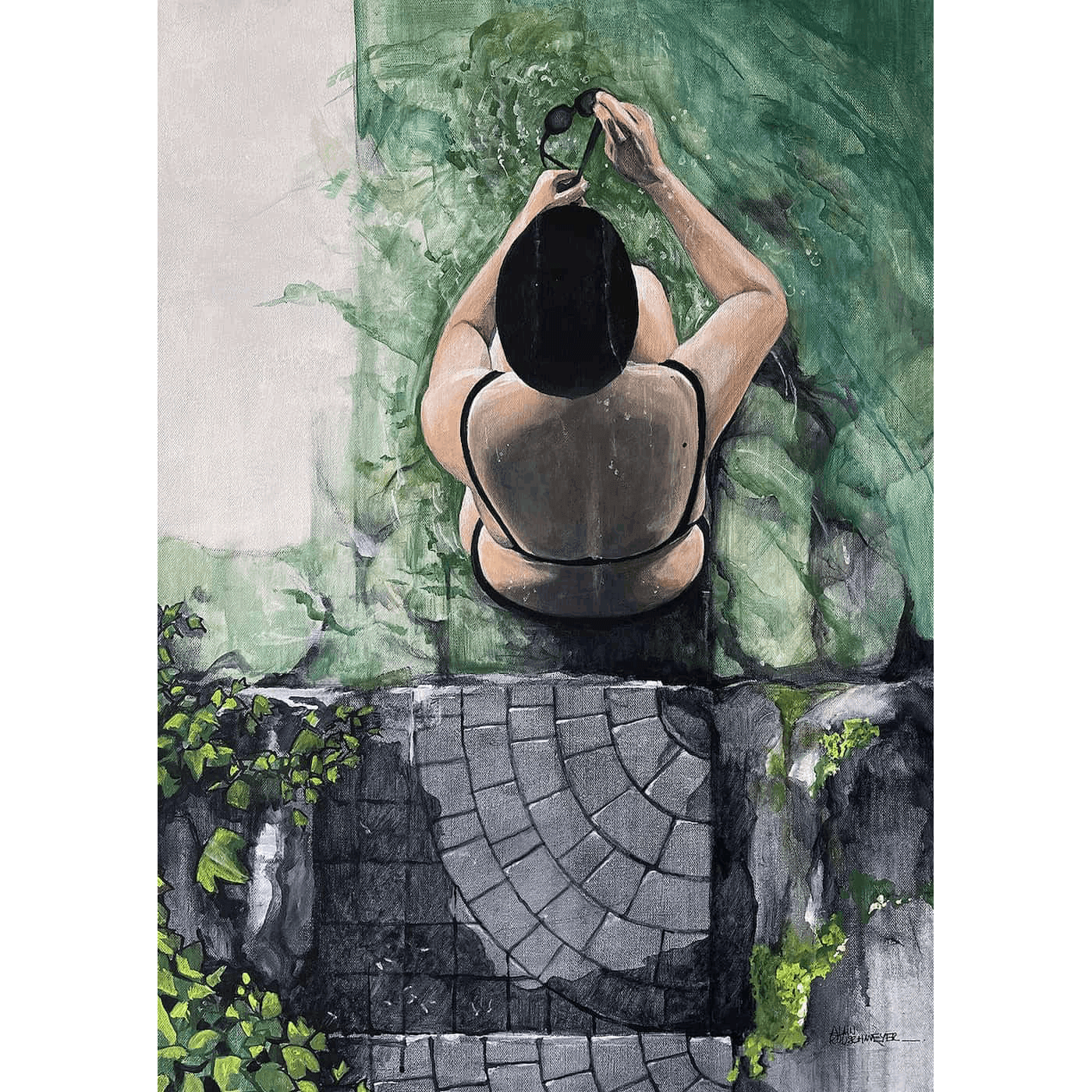
At the edge of the water, she adjusts her goggles with a precise gesture.
Her back exposed to the light, her skin caressed by air and shimmering brightness.
Among the plays of shadow and reflection, one detail catches the eye:
a beauty mark, a tiny island on the sensitive map of her being.
Official Valuation
This artwork benefits from two recognized professional valuations:
View both official valuations
i-CAC: Valuation listed on the official platform for registered professional artists.
Judicial Expert (Pierre Gimenez): Certified appraisal used in legal, tax, and estate contexts.
Technical details
Technique: Acrylic on canvas
Dimensions: 70 x 50 cm
Year: 2024
Support: Canvas on wooden stretcher bars
Framing: unframed
Finish: Satin anti-UV varnish
Certificate: Original signed artwork, delivered with certificate of authenticity
Artistic approach
In "GRAIN DE BEAUTÉ," I sought to explore the intimacy of a suspended moment,
a captured instant between movement and stillness.
Seen from above, the composition highlights the subtle geometry of both place and body,
while the textures of stone and vegetation whisper the silent dialogue between nature and humanity.
Make an offer
Interested in acquiring this piece?
Click here to make an offer
Each painting finds its place, each encounter its rhythm.
Reproduction available
This artwork is also available as a fine art print (on canvas, paper, aluminium…)
to be informed of the possibilities
Price
Secure payment – Free shipping within France – Careful packaging
Directly from the artist’s studio – Leasing available on request
Shipping & returns
Shipping within 7 to 10 business days
Returns accepted within 14 days (see conditions)
The artwork is insured during transit
Legal notices
Duration in Contemporary Figurative Art
Alain Rouschmeyer’s contemporary figurative painting is grounded in an assumed sense of duration. It does not pursue immediate effect. It builds lasting presence. Each contemporary figurative artwork holds a moment and gives it density.
Time intervenes from the sketch stage. Preliminary study allows a deeper understanding of human posture, adjustment of balance, and measurement of tension. The canvas extends this analysis. The gaze moves slowly. It explores lines, masses and distances.
Within this approach, duration becomes a value. The represented body is not captured in a dramatic gesture. It is situated within a structured space. This placement creates stability. It invites attentive viewing.
Contemporary figurative painting here recovers an essential function. It slows perception. It organizes vision. It gives the viewer time to inhabit the scene. In major works from Alain Rouschmeyer’s trajectory, this relationship to time strengthens the coherence between human posture and spatial construction.
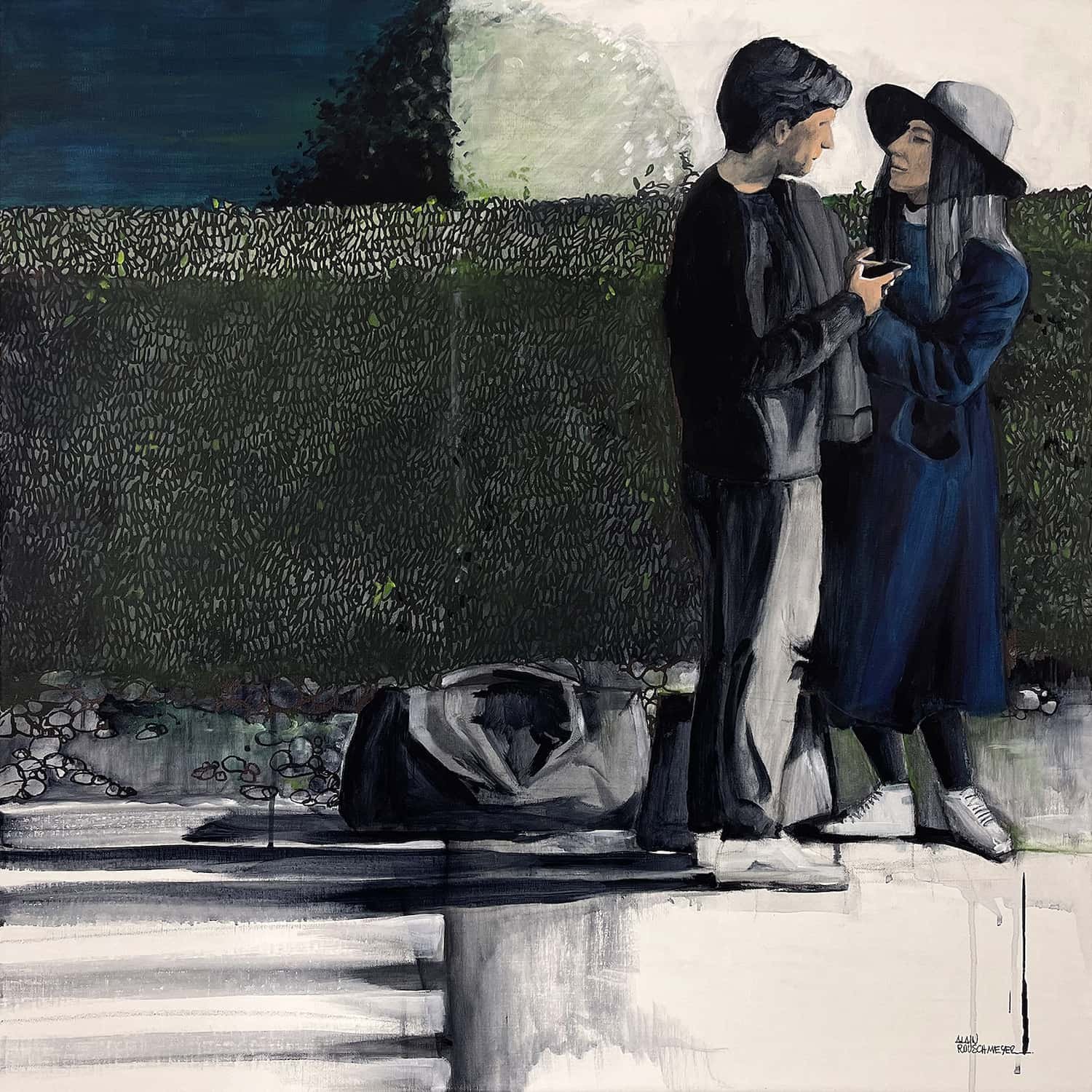
Two figures rooted in the moment.
A lingering glance, a hand brushing against another, a bag resting by their feet...
In this discreet embrace, Pierre and Josepha weave, wordlessly, the fabric of a gentle goodbye or an awaited reunion.
Shadows stretch across the ground, light becomes their silent accomplice.
Everything remains possible, suspended between paths.
Official Valuation
This artwork benefits from two recognized professional valuations:
View both official valuations
i-CAC: Valuation listed on the official platform for registered professional artists.
Judicial Expert (Pierre Gimenez): Certified appraisal used in legal, tax, and estate contexts.
Technical details
Technique: Acrylic on canvas
Dimensions: 80 x 80 cm
Year: 2024
Support: Canvas on wooden stretcher bars
Framing: unframed
Finish: Satin anti-UV varnish
Certificate: Original signed artwork, delivered with certificate of authenticity
Artistic approach
With "PIERRE & JOSEPHA," I continue my exploration of suspended moments —
those fleeting instances where human connection erases the world around, leaving only the essential.
The tension between the dense vegetation and the minimalist esplanade offers a quiet stage,
inviting the viewer to imagine the story beyond the captured scene.
Make an offer
Interested in acquiring this piece?
Click here to make an offer
Each painting finds its place, each encounter its rhythm.
Reproduction available
This artwork is also available as a fine art print (on canvas, paper, aluminium…)
to be informed of the possibilities
Price
Secure payment – Free shipping within France – Careful packaging
Directly from the artist’s studio – Leasing available on request
Shipping & returns
Shipping within 7 to 10 business days
Returns accepted within 14 days (see conditions)
The artwork is insured during transit
Legal notices

A silent exchange, brightened by subtle smiles.
Agathe and Julien seem suspended in a moment of lighthearted complicity,
on a green stage where every gesture holds a hidden promise.
The wet ground mirrors their bond to the sky above,
an understated echo of the mysteries of human connection.
Official Valuation
This artwork benefits from two recognized professional valuations:
View both official valuations
i-CAC: Valuation listed on the official platform for registered professional artists.
Judicial Expert (Pierre Gimenez): Certified appraisal used in legal, tax, and estate contexts.
Technical details
Technique: Acrylic on canvas
Dimensions: 80 x 80 cm
Year: 2024
Support: Canvas on wooden stretcher bars
Framing: unframed
Finish: Satin anti-UV varnish
Certificate: Original signed artwork, delivered with certificate of authenticity
Artistic approach
In "AGATHE & JULIEN," I aimed to capture that fleeting moment when tenderness slips into simple, everyday gestures,
where glances and smiles say everything.
The minimalist setting — a green hedge and shimmering reflections — allows the viewer to focus entirely on the emotional nuance between the two characters.
Make an offer
Interested in acquiring this piece?
Click here to make an offer
Each painting finds its place, each encounter its rhythm.
Reproduction available
This artwork is also available as a fine art print (on canvas, paper, aluminium…)
to be informed of the possibilities
Price
Secure payment – Free shipping within France – Careful packaging
Directly from the artist’s studio – Leasing available on request
Shipping & returns
Shipping within 7 to 10 business days
Returns accepted within 14 days (see conditions)
The artwork is insured during transit
Legal notices
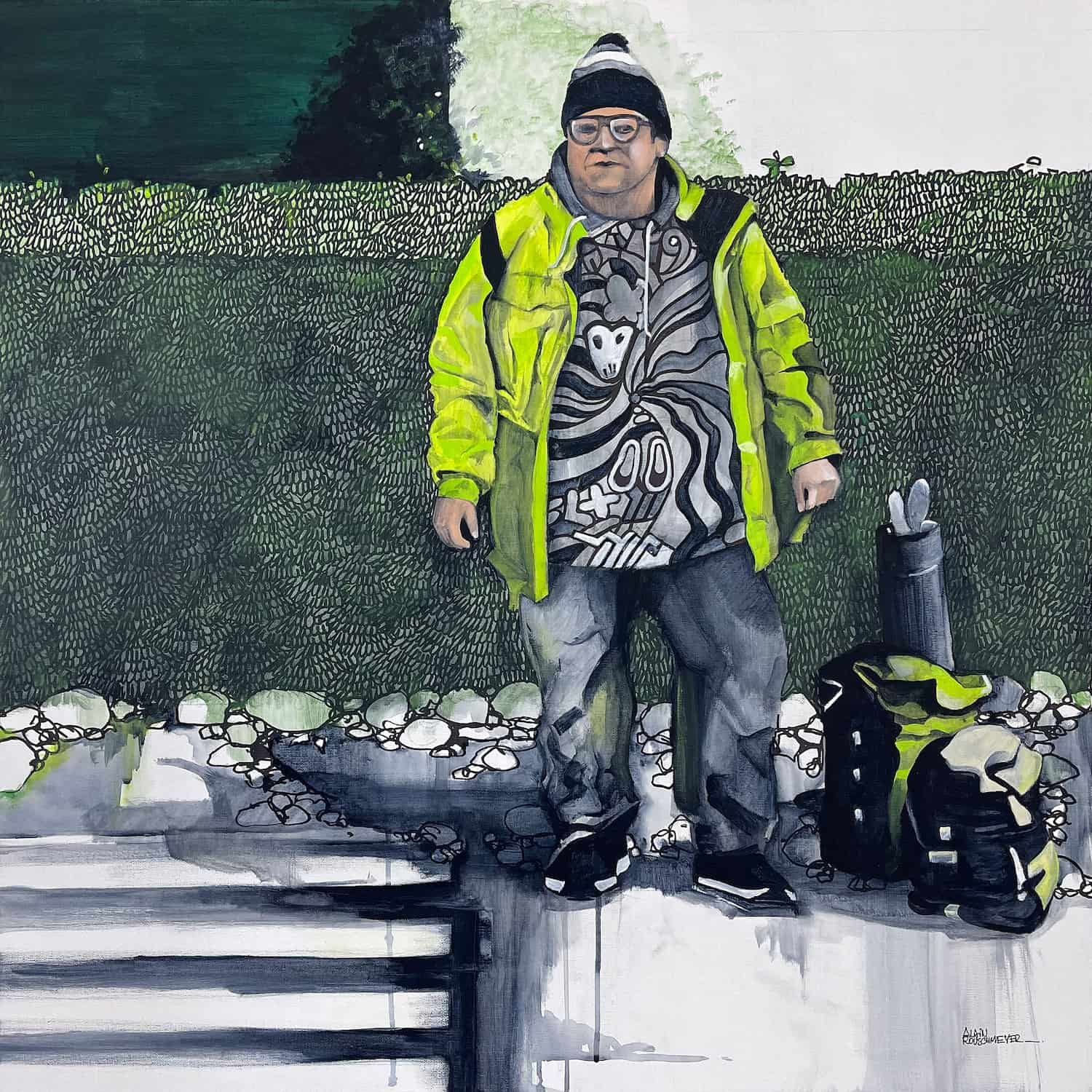
He stands there, solid and unmoving,
like a quiet island amidst the waves of life.
His neon jacket lights up the scene with an unexpected glow,
while his gaze lost on the horizon
reveals the serene simplicity of those who move forward without noise.
Official Valuation
This artwork benefits from two recognized professional valuations:
View both official valuations
i-CAC: Valuation listed on the official platform for registered professional artists.
Judicial Expert (Pierre Gimenez): Certified appraisal used in legal, tax, and estate contexts.
Technical details
Technique: Acrylic on canvas
Dimensions: 80 x 80 cm
Year: 2024
Support: Canvas on wooden stretcher bars
Framing: unframed
Finish: Satin anti-UV varnish
Certificate: Original signed artwork, delivered with certificate of authenticity
Artistic approach
In "PACIFIQUE," I sought to capture the calm strength of an ordinary yet striking figure.
Behind the colorful outfit and slightly offbeat appearance lies profound humanity —
the kind that doesn't need embellishment to fully exist in the moment.
The thick hedge, smooth pavement, and contrasting colors emphasize this balance between the world's extravagance and inner grounding.
Make an offer
Interested in acquiring this piece?
Click here to make an offer
Each painting finds its place, each encounter its rhythm.
Reproduction available
This artwork is also available as a fine art print (on canvas, paper, aluminium…)
to be informed of the possibilities
Price
Secure payment – Free shipping within France – Careful packaging
Directly from the artist’s studio – Leasing available on request
Shipping & returns
Shipping within 7 to 10 business days
Returns accepted within 14 days (see conditions)
The artwork is insured during transit
Legal notices
Associated Works
The reflection developed around human posture, spatial construction and duration takes concrete form in several contemporary figurative paintings by Alain Rouschmeyer. Each artwork establishes a precise dialogue between figure and structure. The body is positioned within a defined framework. Architecture organizes the reading. Composition reveals the initial intention of the sketch.
These contemporary figurative paintings demonstrate coherence. They extend the analysis presented on this page. They show how human posture becomes a spatial reference. They confirm the role of the gaze in the construction of each contemporary figurative artwork.
Below, you can discover a selection of emblematic works that embody this research and structure Alain Rouschmeyer’s trajectory as a contemporary figurative painter.

Gold Medal Winner
2025 International Prize of Art Professionals
Link to award page
The night has laid its silence upon this young woman curled up in the intimacy of blue.
Her legs entwine, the sheets softly ripple like waves of dreams.
Time holds its breath, and in this azure refuge, she almost becomes a painting herself.
Official Valuation
This artwork benefits from two recognized professional valuations:
View both official valuations
i-CAC: Valuation listed on the official platform for registered professional artists.
Judicial Expert (Pierre Gimenez): Certified appraisal used in legal, tax, and estate contexts.
Technical details
Technique: Acrylic on canvas
Dimensions: 100 x 100 cm
Year: 2024
Support: Canvas on wooden stretcher bars
Framing: unframed
Finish: Satin anti-UV varnish
Certificate: Original signed artwork, delivered with certificate of authenticity
Artistic approach
"LA FILLE DANS LES DRAPS BLEUS" explores the dialogue between the body and the sleeping space, where soft light sculpts a gentle geography of folds, skin, and fabric.
The omnipresent blue evokes the depth of dreams, a motionless and infinite inner journey.
It is an ode to the secret stillness of abandoned moments.
Make an offer
Interested in acquiring this piece?
Click here to make an offer
Each painting finds its place, each encounter its rhythm.
Price
Secure payment – Free shipping within France – Careful packaging
Directly from the artist’s studio – Leasing available on request
Shipping & returns
Shipping within 7 to 10 business days
Returns accepted within 14 days (see conditions)
The artwork is insured during transit
Legal notices
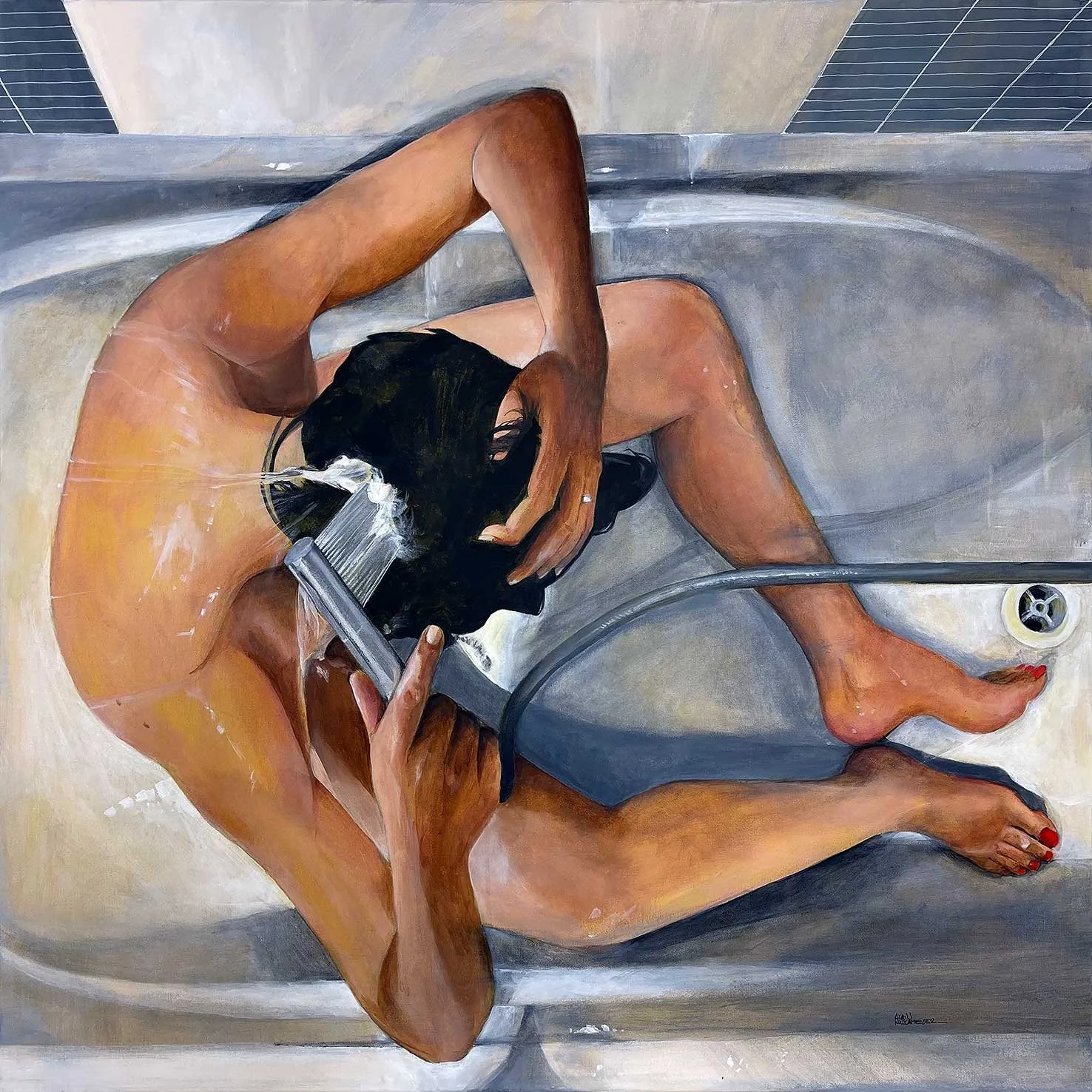
The fragile light of morning bathes this free body, immersed in the whiteness of a silent bathtub.
Simple gestures take on a new weight under the warm stream of water, like an intimate dance with the breaking dawn.
Each movement is a discreet offering to the day awakening.
Official Valuation
This artwork benefits from two recognized professional valuations:
View both official valuations
i-CAC: Valuation listed on the official platform for registered professional artists.
Judicial Expert (Pierre Gimenez): Certified appraisal used in legal, tax, and estate contexts.
Technical details
Technique: Acrylic on canvas
Dimensions: 100 x 100 cm
Year: 2024
Support: Canvas on wooden stretcher bars
Framing: unframed
Finish: Satin anti-UV varnish
Certificate: Original signed artwork, delivered with certificate of authenticity
Artistic approach
"LA FILLE AU LEVER DU JOUR" captures that suspended moment between the end of sleep and the beginning of the world.
The overhead view, almost secretive, celebrates the raw simplicity of a daily ritual: washing, preparing to be reborn.
The confined space of the bathtub becomes a precious setting for the freedom of movement, highlighting the beauty of the ordinary and the power of being alive.
Make an offer
Interested in acquiring this piece?
Click here to make an offer
Each painting finds its place, each encounter its rhythm.
Price
Secure payment – Free shipping within France – Careful packaging
Directly from the artist’s studio – Leasing available on request
Shipping & returns
Shipping within 7 to 10 business days
Returns accepted within 14 days (see conditions)
The artwork is insured during transit
Legal notices

In the silent alcove of morning, bare skin melts into the crumpled sheets.
Everything is surrender, everything is breath still suspended between night and day.
The intimacy of sleep lingers, fragile and untouched, within the soft embrace of fabric.
Official Valuation
This artwork benefits from two recognized professional valuations:
View both official valuations
i-CAC: Valuation listed on the official platform for registered professional artists.
Judicial Expert (Pierre Gimenez): Certified appraisal used in legal, tax, and estate contexts.
Technical details
Technique: Acrylic on canvas
Dimensions: 100 x 100 cm
Year: 2024
Support: Canvas on wooden stretcher bars
Framing: unframed
Finish: Satin anti-UV varnish
Certificate: Original signed artwork, delivered with certificate of authenticity
Artistic approach
"LA FILLE NUE DANS SON LIT" captures the luminous vulnerability of the moment when the body, still surrendered to sleep, converses with the folds and patterns of the bedding.
Seen from above, the perspective offers a tender and discreet glimpse into this in-between state, where reality and dreams remain entangled.
The deep blues of the sheets contrast with the warmth of the skin, enhancing the poetic resonance of this intimate and fleeting scene.
Make an offer
Interested in acquiring this piece?
Click here to make an offer
Each painting finds its place, each encounter its rhythm.
Reproduction available
This artwork is also available as a fine art print (on canvas, paper, aluminium…)
to be informed of the possibilities
Price
Secure payment – Free shipping within France – Careful packaging
Directly from the artist’s studio – Leasing available on request
Shipping & returns
Shipping within 7 to 10 business days
Returns accepted within 14 days (see conditions)
The artwork is insured during transit
Legal notices
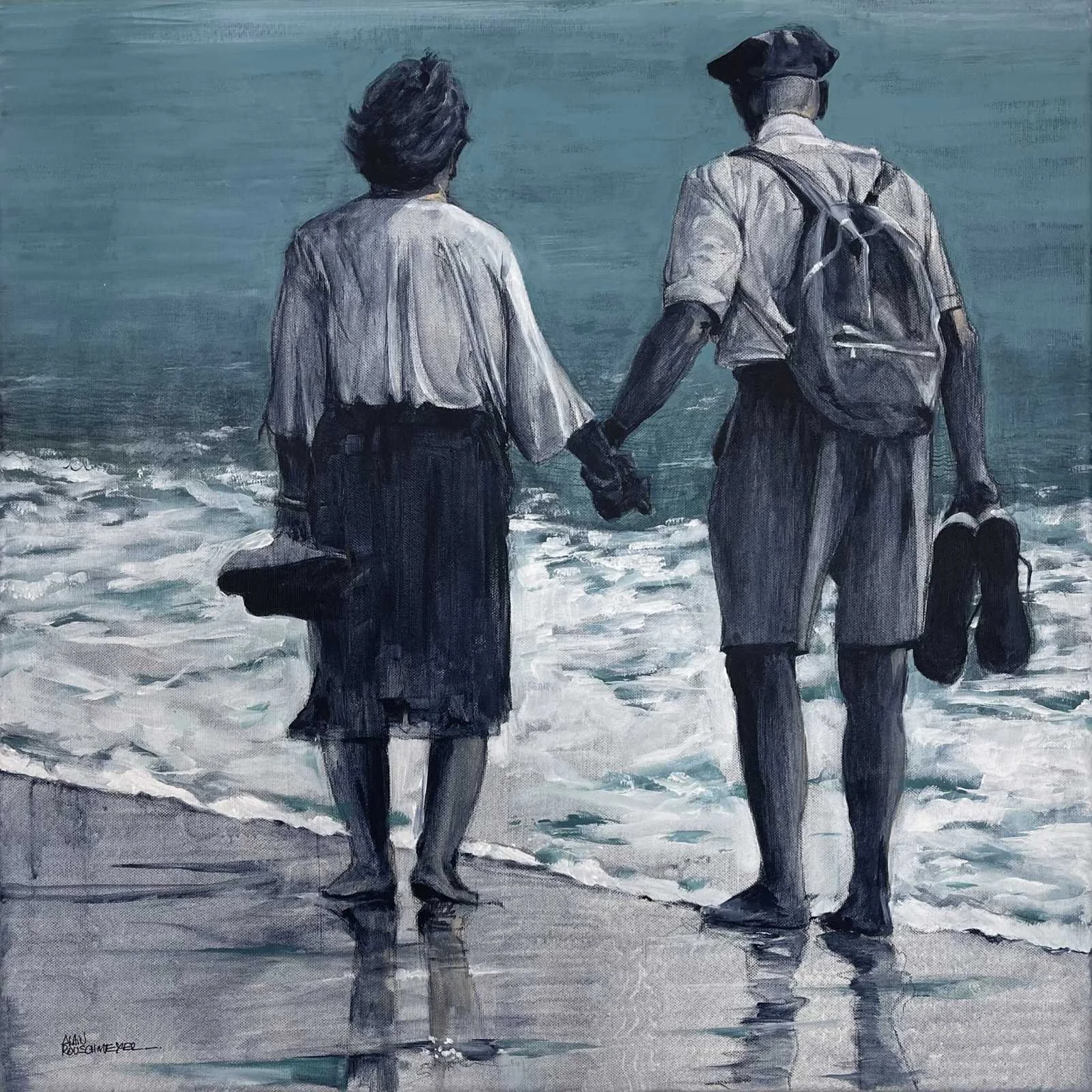
The Lovers by the Sea —
Two silhouettes facing the sea, bound by the years and by a shared presence.
The work explores the silent relationship between body, landscape, and time, revealing the fragility and strength of a discreet bond.
Technical Details
Medium: Acrylic on canvas
Dimensions: 60 × 60 cm (depth 2 cm)
Year: 2025
Support: Canvas stretched on wooden frame
Framing: Unframed
Finish: Satin anti-UV varnish – painted edges – ready to hang
Certificate: Original signed artwork, delivered with a certificate of authenticity and an international registration certificate
Fine Art Prints – Limited Edition
Access the collector’s limited and numbered edition (10 copies)
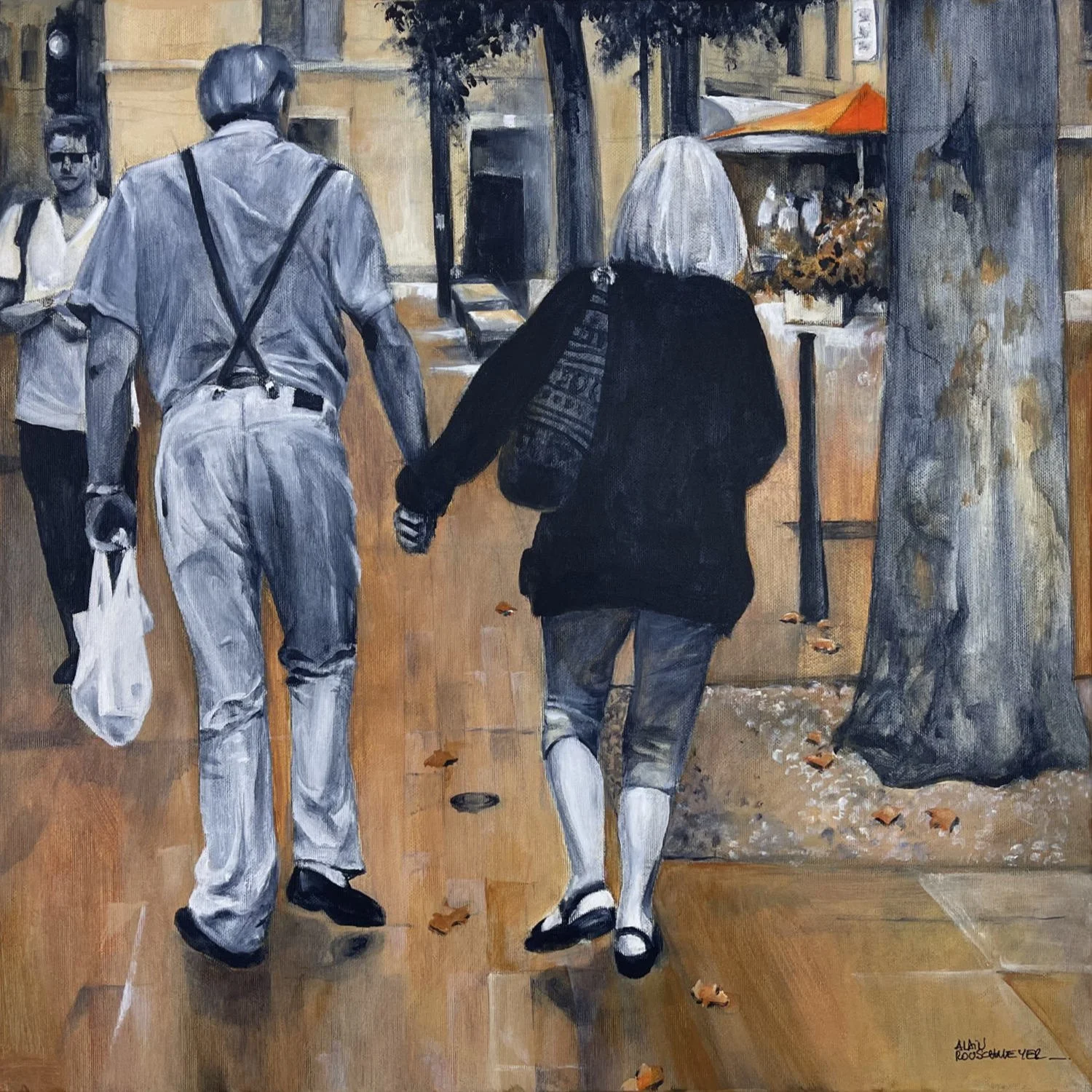
The Lovers of the Old Town…
They walk side by side, carried by a shared rhythm, in the soft light of a familiar city.
Their bodies tell the story of time better than faces do: an unhurried pace, a hand held, the continuity of a shared step.
Between architecture and human presence, the work reveals an ordinary yet profound love, rooted in the simplest gestures of everyday life.
Technical Details
Medium: Acrylic on canvas
Dimensions: 50 × 50 cm (depth 2 cm)
Year: 2025
Support: Canvas stretched on wooden frame
Framing: Unframed
Finish: Satin anti-UV varnish – painted edges – ready to hang
Certificate: Original signed artwork, delivered with a certificate of authenticity and an international registration certificate
Fine Art Prints – Limited Edition
Access the collector’s limited and numbered edition (10 copies)
Frequently Asked Questions on Contemporary Figurative Painting
-
Contemporary figurative painting represents recognizable forms, primarily the human figure, while engaging with present-day concerns. It does not aim at academic reproduction of reality. It interprets posture, space and presence. In Alain Rouschmeyer’s work, contemporary figurative painting articulates the body and architectural structure in order to construct a coherent and organized visual reading.
-
Architecture introduces compositional rigor. It structures space. It organizes the guiding lines of a contemporary figurative artwork. In Alain Rouschmeyer’s practice, architectural training influences framing, depth and the relationship between human posture and its environment. Space becomes an active element. It conditions bodily presence and directs the gaze.
-
Human posture reveals the relationship between the body and place. It expresses tension, stability or distance. In Alain Rouschmeyer’s contemporary figurative art, posture is not incidental. It measures space. It structures the scene. It provides the viewer with a clear anchor within the composition.
This analysis continues on the page REGARDS, where the relationship between spatial structure and human posture is examined in depth. It is further developed in Body and Space and in Duration, which respectively explore the inscription of the body within a defined place and the question of time in contemporary figurative painting.
These complementary sections reinforce the conceptual framework of Alain Rouschmeyer’s contemporary figurative painting. They clarify how architectural space structures composition, how human posture becomes a spatial reference, and how duration shapes the viewer’s experience.
• REGARDS
• Gaze and Architecture
• Body and Space
• Duration
• About
• Available Works


