
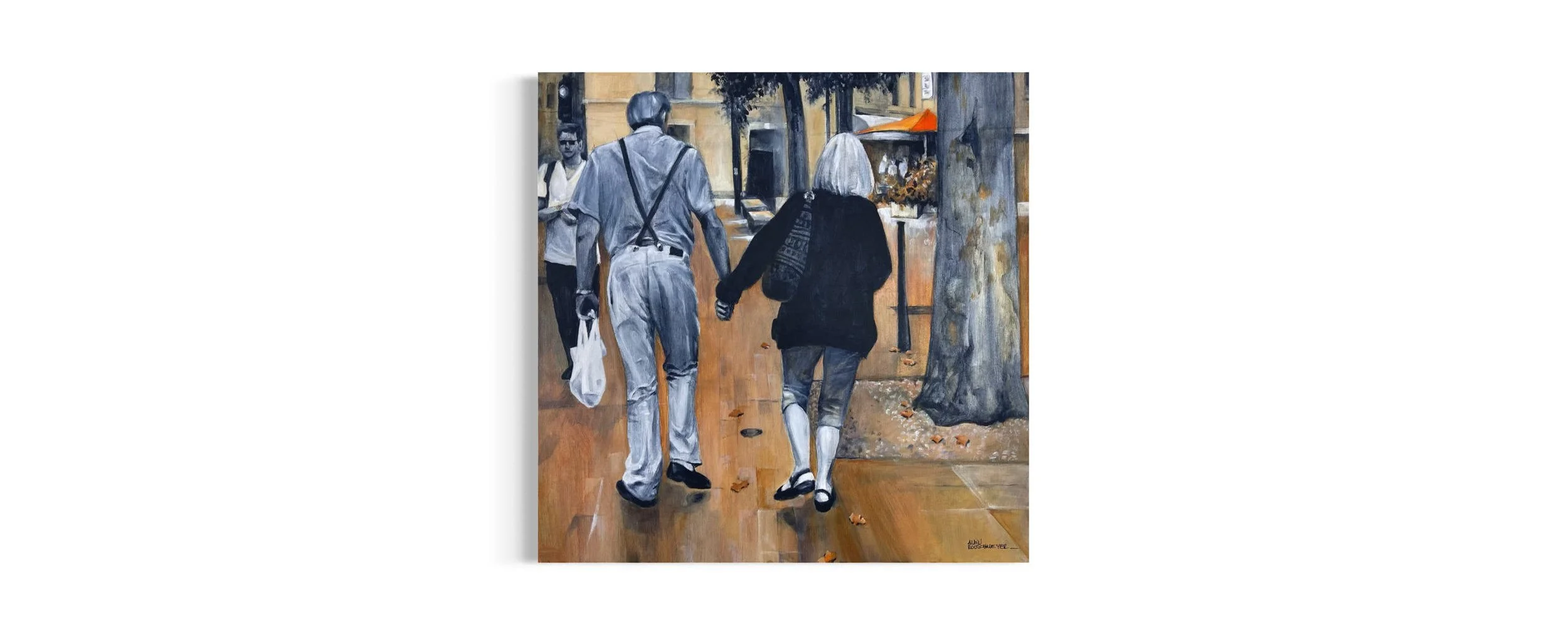
Les amoureux de la vieille ville | 50 x 50 cm
Contemporary figurative painting by Alain Rouschmeyer, human gaze within architectural space
The Blur of the Figurative
Contemporary figurative painting now operates within an expanded field in which the very notion of the figure appears diluted. The term figurative often refers to highly diverse practices, sometimes detached from a constructed and rigorous representation. One speaks of expanded figuration, of suggested presence, of hybrid territories between abstraction and recognition. The figure remains, yet its status shifts. It becomes trace, citation, index.
This shift is not neutral. It transforms the responsibility of the image. The figure may appear without its construction being fully assumed. It becomes one element among others, sometimes interchangeable.
I do not situate my work within that dilution.
For me, the figurative remains a demanding position. It requires construction. It requires attention to posture. It requires articulation between body and space. To represent does not mean to reproduce. It means to organize presence.
The figurative is not a compromise between abstraction and recognition. It is a commitment to the visible
The Gaze as Responsibility
My work is structured around the gaze. Not the gaze of the viewer as final recipient, but the gaze as internal tension within the image. A slight inclination of the head, a line of the shoulder, a subtle torsion of the torso can shift the balance of an entire painting.
In La Fille dans les Draps Bleus, the figure is not merely reclining. She is contained within a constructed field. The folds, the color, the line of the sheet structure the space. The posture establishes a silent situation. The image does not narrate a story. It proposes stabilized presence.
In the series Les Amoureux, the distance between two bodies matters more than their proximity. The gaze circulates between them. The space separating them becomes active. Tension does not reside in a dramatic gesture. It emerges from the fragile equilibrium of posture.
What matters to me is that figurative moment when human posture suggests attachment. The moment is not photographic. It is constructed. It results from observation, sketching and successive adjustments.
The gaze does not capture. It organizes.
Architecture and Construction
My architectural training profoundly structures my painting. It taught me to consider space as organization rather than décor. Masses, voids, lines of force and invisible axes compose a structured field.
In La Fille dans les Draps Bleus, the vertical plane of the background, the horizontal tension of the bed and the oblique of the body create a contained dynamic. Nothing is arbitrary. Space frames posture.
In outdoor works, even a discreet architectural presence acts as counterpoint to the body. A wall, a ground line, an opening introduce constraint. The body does not float. It is situated.
Architecture is not background. It is partner. It stabilizes or destabilizes the figure. It creates tension.
Composition emerges from a balance between academic rigor and contemporary spatial awareness. Rigor does not imply rigidity. It implies structural necessity.
The body is always situated.
Body, Density and Restraint
Contemporary figurative painting can sometimes yield to immediate bodily seduction. I refuse that facility. The body is neither decorative nor spectacular. It is a point of density within a structured field.
Flesh is not treated for itself. It exists in relation. It engages with void, with light, with surface.
Restraint matters. A minimal gesture is sufficient. A slightly turned shoulder, a shifted leg, a resting hand can transform the perception of the whole.
The body does not seek effect. It seeks accuracy.
That accuracy results from sustained work. Sketches, studies, revisions. The figurative moment does not appear spontaneously. It is constructed.
Against Conceptual Superficiality
The contemporary context often privileges discourse as primary foundation of the work. Concept may accompany painting. It must not replace it.
When an image depends entirely on explanatory text, it relinquishes strength. Conceptual superficiality, when detached from visual necessity, weakens responsibility.
I do not reject thought. I assume a position. But that position must translate plastically. Painting does not justify itself. It holds through structure.
An artwork must not be understood solely through language. It must be sustained by composition.
Lineage and Position
I acknowledge dialogue with figures in the history of painting. Edward Hopper for the silent tension between architecture and solitude. Egon Schiele for the incisive truth of posture. John Singer Sargent for the discipline of gaze and mastery of material.
These references are not models to replicate. They are markers. They remind us that a figure can carry intensity without spectacle.
Figurative painting is not a residue of the past. It remains an active field.
Duration and Maturity of the Gaze
My practice unfolds over long duration. Painting now concerns consolidation rather than emergence. Trajectory matters as much as gesture.
Time refines the gaze. It allows reduction. Simplification. Stabilization.
Recent international recognition of my work does not constitute an endpoint. It signals that constructed contemporary figurative painting can still occupy a place within the current landscape.
The figurative is neither nostalgic nor reactionary. It remains a space of responsibility.
In a world saturated with rapid images, painting can propose another rhythm. Construction. Stabilized presence.
To encounter and paint that figurative moment when human posture suggests attachment. This defines a method. Observe. Construct. Balance. Stabilize.
Contemporary figurative painting, when it assumes rigor, remains a field of tension between body and architecture, silence and presence, restraint and density.
It is within that tension that I situate my work.
Read → Body and Space in Contemporary Figurative Painting
Explore the Research Axes
This reflection extends across several interconnected sections that structure Alain Rouschmeyer’s contemporary figurative painting. Each page develops a specific axis of research. Together, they articulate a coherent position on human posture, architectural space and duration.
Return to REGARDS
A conceptual overview of the gaze as structural principle in contemporary figurative painting.
Gaze and Architecture
An in-depth analysis of how spatial construction shapes human presence within the composition.
Read → Body and Space
A focused study on how posture defines spatial balance and anchors the figure within a constructed environment.
Read → Duration
An exploration of time, slowness and sustained observation in contemporary figurative art.


