
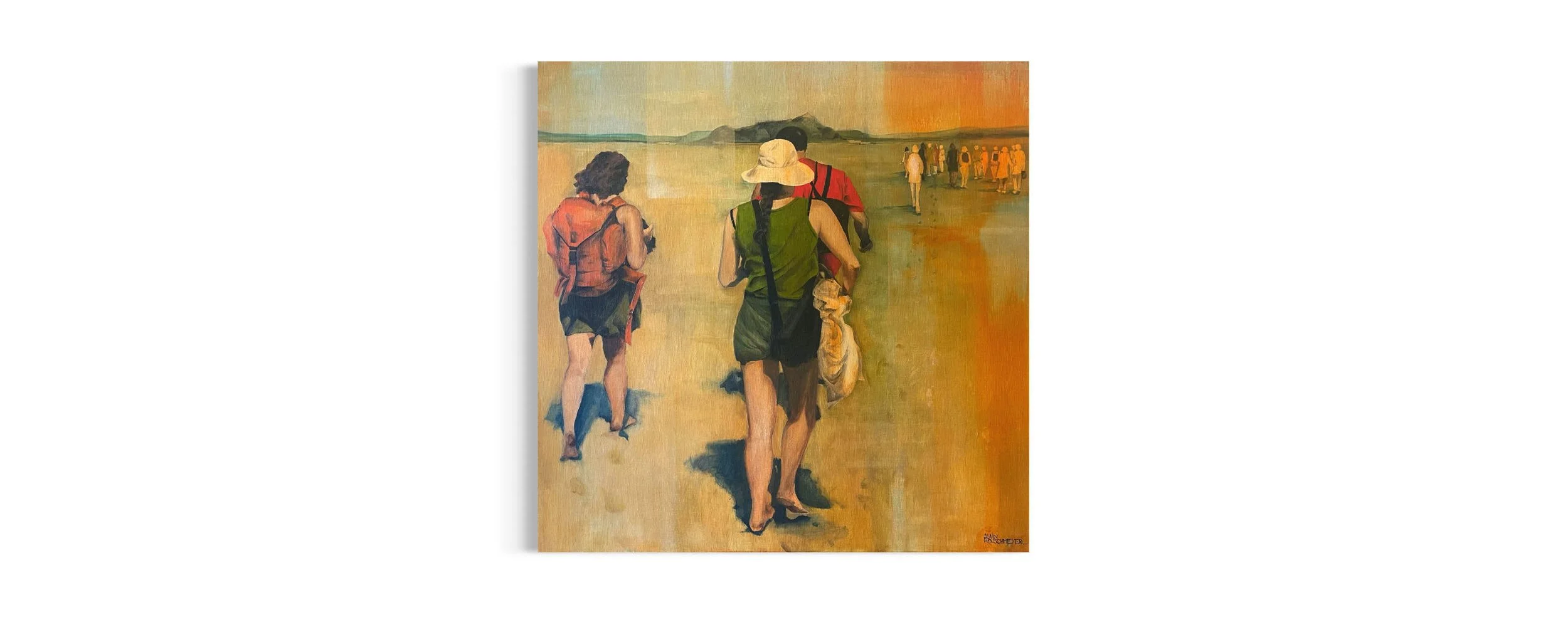
La grande traversée 2 | 80 x 80 cm
Body and Space in Contemporary Figurative Painting
Contemporary figurative painting examines the relationship between body and space. Human posture does not float. It is situated within structure. In Alain Rouschmeyer’s work, each contemporary figurative painting constructs a precise dialogue between presence and frame. The body becomes a reference point. It measures the place. It reveals depth.
This reflection extends the analysis developed on the REGARDS page, dedicated to contemporary figurative painting and the construction of the gaze. Here, the focus shifts toward balance between figure and space.
Posture as a Point of Anchor
Human posture forms the center of gravity of a contemporary figurative painting. The inclination of the body, the support of a foot, the direction of the gaze organize the composition. Contemporary figurative painting gains stability when the figure fully assumes its place within space.
The Body in Relation to Structure
The body engages with lines. Vertical axes, horizontal planes, successive layers. Space is not a backdrop. It acts as structure. In Alain Rouschmeyer’s work, the relationship between human posture and architectural framing strengthens the clarity of the scene.

Collector print in a limited edition (10 copies).
Fine Art, numbered and signed – image size 50 x 50 cm.
With a 5 cm white border: 60 × 60 cm
Digigraphie® certified Fine Art print
Hahnemühle Photo Rag 308 gsm paper
View the original artwork here.

She sits cross-legged on the wrinkled bed, arms folded.
The silence of the room echoes her drifting thoughts.
Her gaze lingers, suspended.
She has just set aside her translation tools, the hum of industry still ringing —
yet her mind begins to float, gently, elsewhere.
Official Valuation
This artwork benefits from two recognized professional valuations:
View both official valuations
i-CAC: Valuation listed on the official platform for registered professional artists.
Judicial Expert (Pierre Gimenez): Certified appraisal used in legal, tax, and estate contexts.
Technical details
Technique: Acrylic on canvas
Dimensions: 50 x 50 cm
Year: 2022
Support: Canvas on wooden stretcher bars
Framing: framed in a natural light wood American box frame
Finish: Satin anti-UV varnish
Certificate: Original signed artwork, delivered with certificate of authenticity
Artistic approach
With SONGEUSE, I aimed to capture the moment when activity ceases and the body grants itself a pause.
This woman embodies the transition from focused work to inner stillness.
The undone bed, the drawn lamps, the delicately patterned blouse —
all shape a scene suspended between reality and sketch, where lines remain visible.
This painting is a quiet tribute to those fleeting moments of introspection.
Make an offer
Interested in acquiring this piece?
Click here to make an offer
Each painting finds its place, each encounter its rhythm.
Reproduction available
This artwork is also available as a fine art print (on canvas, paper, aluminium…)
to be informed of the possibilities
Price
Secure payment – Free shipping within France – Careful packaging
Directly from the artist’s studio – Leasing available on request
Shipping & returns
Shipping within 7 to 10 business days
Returns accepted within 14 days (see conditions)
The artwork is insured during transit
Legal notices
Drawing as Spatial Analysis
The sketch precedes the canvas. It allows analysis of masses and distances. Human posture is tested, shifted and adjusted. This method gives contemporary figurative painting structural coherence. The body is never isolated. It belongs to a constructed field.
Associated Works
This relationship between body and space is manifested in several contemporary figurative paintings from Alain Rouschmeyer’s trajectory. The following works illustrate the tension between human posture and spatial structure.

Under her light hat, she walks barefoot, carried by summer.
Her smile sketches a tender thought — a simple dream of escape:
to find again her favorite deckchair, or to imagine it here, along the path.
The light bites into colors, sand mingles with stones,
and already her mind drifts far beyond her moving steps.
Somewhere between walking and dreaming, she is elsewhere.
Official Valuation
This artwork benefits from two recognized professional valuations:
View both official valuations
i-CAC: Valuation listed on the official platform for registered professional artists.
Judicial Expert (Pierre Gimenez): Certified appraisal used in legal, tax, and estate contexts.
Technical details
Technique: Oil on canvas
Dimensions: 80 x 80 cm
Year: 2022
Support: Canvas on wooden stretcher bars
Framing: no frame
Finish: Satin anti-UV varnish
Certificate: Original signed artwork, delivered with certificate of authenticity
Artistic approach
With DESTINATION MONT ST MICHEL, I sought to capture that suspended instant —
the space between forward motion and the yearning for rest.
The young woman walks, yet her inner gaze transports her to a softer world:
the simple joy of a deckchair, a promised pause.
The artwork blends finished figuration and sketched outlines,
echoing the coexistence of reality and imagination.
A painting about the quiet dreams that color our paths.
Make an offer
Interested in acquiring this piece?
Click here to make an offer
Each painting finds its place, each encounter its rhythm.
Reproduction available
This artwork is also available as a fine art print (on canvas, paper, aluminium…)
to be informed of the possibilities
Price
Secure payment – Free shipping within France – Careful packaging
Directly from the artist’s studio – Leasing available on request
Shipping & returns
Shipping within 7 to 10 business days
Returns accepted within 14 days (see conditions)
The artwork is insured during transit
Legal notices

On the cool sand, she moves forward, hesitant.
The heavy black dog pulls her at his own pace,
and her multiplied steps reveal the learning of a still unfamiliar world.
Around her, white, windowless houses —
silent architecture shielding the fragile momentum of her journey.
It is a crossing, a new land to tame,
a chapter of life yet to be written.
Official Valuation
This artwork benefits from two recognized professional valuations:
View both official valuations
i-CAC: Valuation listed on the official platform for registered professional artists.
Judicial Expert (Pierre Gimenez): Certified appraisal used in legal, tax, and estate contexts.
Technical details
Technique: Oil on canvas
Dimensions: 80 x 80 cm
Year: 2022
Support: Canvas on wooden stretcher bars
Framing: no frame
Finish: Satin anti-UV varnish
Certificate: Original signed artwork, delivered with certificate of authenticity
Artistic approach
With NEW LAND, I sought to depict the delicate moment of trying to find one's footing in a foreign world.
The young woman, with her uncertain, multiplied stance, speaks of tentative exploration,
of a blend of apprehension and hope.
The massive Newfoundland dog serves as both guide and reassuring companion.
The blank architecture suggests the need for silence, for invisible spaces where transformation can quietly occur.
It is a painting about the quiet courage of beginning anew.
Make an offer
Interested in acquiring this piece?
Click here to make an offer
Each painting finds its place, each encounter its rhythm.
Reproduction available
This artwork is also available as a fine art print (on canvas, paper, aluminium…)
to be informed of the possibilities
Price
Secure payment – Free shipping within France – Careful packaging
Directly from the artist’s studio – Leasing available on request
Shipping & returns
Shipping within 7 to 10 business days
Returns accepted within 14 days (see conditions)
The artwork is insured during transit
Legal notices

They have just arrived, still glowing with the light of the journey.
Barefoot on new ground, each member drifts in their own way —
one captures the place through the screen of a phone,
another peers into the water's edge,
while the youngest squat down, little explorers in the making.
It is the tender moment of first bearings,
when a place begins to whisper its promises.
Official Valuation
This artwork benefits from two recognized professional valuations:
View both official valuations
i-CAC: Valuation listed on the official platform for registered professional artists.
Judicial Expert (Pierre Gimenez): Certified appraisal used in legal, tax, and estate contexts.
Technical details
Technique: Oil on canvas
Dimensions: 80 x 80 cm
Year: 2022
Support: Canvas on wooden stretcher bars
Framing: framed in a natural light wood American box frame
Finish: Satin anti-UV varnish
Certificate: Original signed artwork, delivered with certificate of authenticity
Artistic approach
With FINDING BEARINGS, I wanted to capture the discreet magic of encountering a new place:
when each family member lays claim to it in their own rhythm,
guided by personal desires and curiosities.
The scene, blending realism and sketch-like touches, expresses the inner buzz,
the overlapping excitement and expectations.
It is a painting about discovery — the elusive instant when one starts belonging somewhere.
Make an offer
Interested in acquiring this piece?
Click here to make an offer
Each painting finds its place, each encounter its rhythm.
Reproduction available
This artwork is also available as a fine art print (on canvas, paper, aluminium…)
to be informed of the possibilities
Price
Secure payment – Free shipping within France – Careful packaging
Directly from the artist’s studio – Leasing available on request
Shipping & returns
Shipping within 7 to 10 business days
Returns accepted within 14 days (see conditions)
The artwork is insured during transit
Legal notices
Frequently Asked Questions on Body and Space in Contemporary Figurative Painting
-
Human posture functions as an anchoring point within the composition. It determines axes, distances and balance in a contemporary figurative painting. In Alain Rouschmeyer’s work, the body does not float. It is situated within a precise spatial organization. Inclination, support and orientation of the gaze construct the relationship between figure and environment. Posture becomes a structuring element of space.
-
Contemporary figurative art does not merely represent a body. It analyzes its presence within a place. The relationship between body and space creates depth within the scene. It organizes the reading of the contemporary figurative artwork. In Alain Rouschmeyer’s painting, this interaction establishes coherence between human posture and spatial structure. The body reveals the architecture of the frame.
-
The sketch allows the study of masses, proportions and lines of force. It precedes the painting and clarifies the relationship between figure and structure. In contemporary figurative painting, drawing is an essential stage. It establishes the balance between human posture and space. It ensures the coherence of the contemporary figurative artwork before the application of color.
Explore the Research Axes
This reflection extends across several interconnected sections that structure Alain Rouschmeyer’s contemporary figurative painting. Each page develops a specific axis of research. Together, they articulate a coherent position on human posture, architectural space and duration.
Return to REGARDS
A conceptual overview of the gaze as structural principle in contemporary figurative painting.
Read → Gaze and Architecture
An in-depth analysis of how spatial construction shapes human presence within the composition
Body and Space
A focused study on how posture defines spatial balance and anchors the figure within a constructed environment.
Read → Duration
An exploration of time, slowness and sustained observation in contemporary figurative art.


