
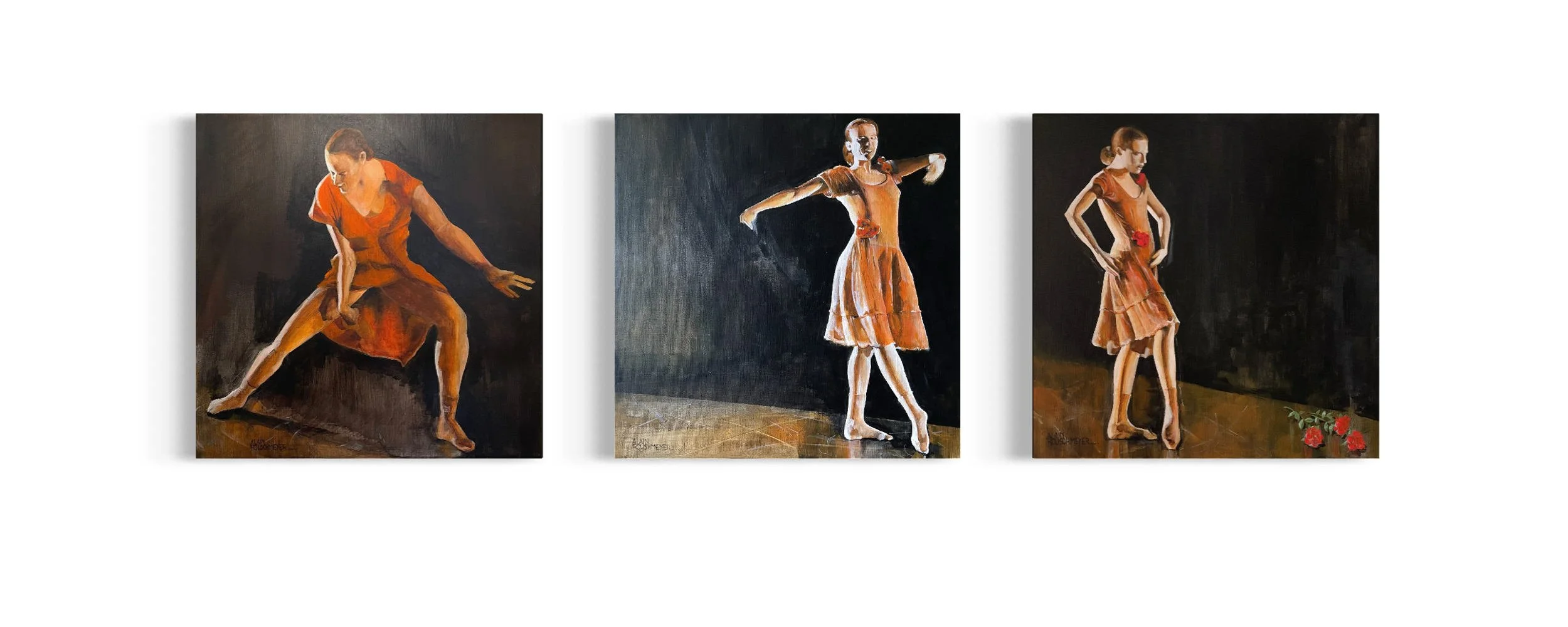
ancrage | allégorie | posture - 3 X 50 x 50cm
Duration, Trajectory and the Maturity of the Gaze
Contemporary figurative painting unfolds over time. It does not pursue immediate effect. It builds a trajectory. In Alain Rouschmeyer’s work, duration structures the gaze. It allows a deeper understanding of human posture and refines the relationship between body and space.
Each contemporary figurative painting relies on a slow process. The sketch precedes the canvas. Compositional analysis precedes color. This progression gives the gaze maturity. It situates the figure within a coherent construction.
This reflection extends the framework developed on the REGARDS page, dedicated to contemporary figurative painting and spatial structure. Here, time becomes essential. It organizes artistic trajectory. It consolidates coherence between human posture and spatial construction.
The Held Moment in Contemporary Figurative Painting
Contemporary figurative painting does not capture a spectacular gesture. It holds a stable moment. It observes human posture within duration. The represented instant is not fleeting. It is constructed. It is weighed. It is embedded in a deliberate composition.
In Alain Rouschmeyer’s work, this held moment rests on rigorous preparation. The sketch analyzes points of support. It measures distances. It clarifies the relationship between body and space. The contemporary figurative painting extends this study. It establishes balance.
The moment becomes an anchoring point. It does not seek immediate emotion. It installs presence. It allows the viewer to enter the scene and explore its structure. This assumed slowness reinforces coherence between human posture and spatial construction.

Under the soft shadow of a leisurely afternoon,
she stretches out, book in hand, her mind adrift,
languid on the velvet of her couch.
On the round table, a plate of pistachios, a glass of grenadine;
like fragments of simple joy,
time drips away slowly, deliciously, suspended.
Official Valuation
This artwork benefits from two recognized professional valuations:
View both official valuations
i-CAC: Valuation listed on the official platform for registered professional artists.
Judicial Expert (Pierre Gimenez): Certified appraisal used in legal, tax, and estate contexts.
Technical details
Technique: Acrylic on canvas
Dimensions: 100 x 100 cm
Year: 2023
Support: Canvas on wooden stretcher bars
Framing: framed in a natural light wood American box frame
Finish: Satin anti-UV varnish
Certificate: Original signed artwork, delivered with certificate of authenticity
Artistic approach
With PISTACHIO AND GRENADINE, I wanted to capture that fleeting moment where life grants itself a tender pause.
The overhead composition invites the viewer into the intimacy of a daily ritual, transformed by warm light and vibrant colors.
The bright red dress, the everyday objects — pistachios, grenadine —
become symbols of discreet hedonism, a quiet celebration of the present moment.
A pictorial homage to life's gentle pleasures.
Make an offer
Interested in acquiring this piece?
Click here to make an offer
Each painting finds its place, each encounter its rhythm.
Reproduction available
This artwork is also available as a fine art print (on canvas, paper, aluminium…)
to be informed of the possibilities
Price
Secure payment – Free shipping within France – Careful packaging
Directly from the artist’s studio – Leasing available on request
Shipping & returns
Shipping within 7 to 10 business days
Returns accepted within 14 days (see conditions)
The artwork is insured during transit
Legal notices

An infinite checkerboard, intersecting paths.
Two players lean over the chessboard of their thoughts, engaged in silent dialogue.
Around them, the ground hums with history and architecture, a murmur of stone and shadows.
In this game of strategies and glances, geometry becomes language, and heritage, a stage.
Official Valuation
This artwork benefits from two recognized professional valuations:
View both official valuations
i-CAC: Valuation listed on the official platform for registered professional artists.
Judicial Expert (Pierre Gimenez): Certified appraisal used in legal, tax, and estate contexts.
Technical details
Technique: Acrylic on canvas
Dimensions: 100 x 100 cm
Year: 2024
Support: Canvas on wooden stretcher bars
Framing: Framed with light wood American case
Finish: Satin anti-UV varnish
Certificate: Original signed artwork, delivered with certificate of authenticity
Artistic approach
With "Heritage Geometry", I sought to explore the echo of places on human presence.
The aerial perspective, the graphic tension of the checkerboard, and the architectural elements amplify the feeling of a suspended space where every move leaves its imprint, and every decision echoes through time.
The playful confrontation unfolds within a broader dialogue with the materiality of memory.
Make an offer
Interested in acquiring this piece?
Click here to make an offer
Each painting finds its place, each encounter its rhythm.
Price
Secure payment – Free shipping within France – Careful packaging
Directly from the artist’s studio – Leasing available on request
Shipping & returns
Shipping within 7 to 10 business days
Returns accepted within 14 days (see conditions)
The artwork is insured during transit
Legal notices
Artistic Trajectory and the Construction of the Gaze
Alain Rouschmeyer’s contemporary figurative painting unfolds within a trajectory. It does not proceed through rupture. It advances through deepening. The gaze is built over years. It gains precision. It gains stability.
Each period refines the relationship between human posture and space. Lines become more controlled. Composition becomes more rigorous. The contemporary figurative painting is not an isolated object. It belongs to a coherent body of work.
This trajectory rests on sustained drawing practice. The sketch accompanies the evolution of the gaze. It allows a return to essentials. It structures visual thinking. Contemporary figurative painting becomes a durable field of exploration.
Duration consolidates this construction. It gives the work continuity. It situates human posture within a process of maturation. The gaze no longer seeks effect. It seeks accuracy.

Under a light sky, steps stretch across the endless sandy expanse.
Each figure moves forward, carried by the same breath,
yet each draws their own invisible path,
guided by affinities, exchanged glances, and emerging bonds.
The sea has retreated, offering a suspended space
where connections weave themselves in the rhythm of walking.
Official Valuation
This artwork benefits from two recognized professional valuations:
View both official valuations
i-CAC: Valuation listed on the official platform for registered professional artists.
Judicial Expert (Pierre Gimenez): Certified appraisal used in legal, tax, and estate contexts.
Technical details
Technique: Acrylic on canvas
Dimensions: 80 x 80 cm
Year: 2022
Support: Canvas on wooden stretcher bars
Framing: no frame
Finish: Satin anti-UV varnish
Certificate: Original signed artwork, delivered with certificate of authenticity
Artistic approach
With THE GREAT CROSSING 1, I sought to capture the quiet poetry of a shared walk:
moving forward together, yet separately,
where closeness forms silently through shared emotion.
The wet sand reflects gentle tones, and the figures slowly inhabit this fleeting space.
With vibrant colors and unfinished sketches,
I suggest the fragile beauty of these transient companions,
united for a moment by the simple grace of the journey.
Make an offer
Interested in acquiring this piece?
Click here to make an offer
Each painting finds its place, each encounter its rhythm.
Reproduction available
This artwork is also available as a fine art print (on canvas, paper, aluminium…)
to be informed of the possibilities
Price
Secure payment – Free shipping within France – Careful packaging
Directly from the artist’s studio – Leasing available on request
Shipping & returns
Shipping within 7 to 10 business days
Returns accepted within 14 days (see conditions)
The artwork is insured during transit
Legal notices

Under soft light, the sand becomes an inner path.
Each step, each silhouette carries its own hidden drive,
its own silent purpose.
The group moves forward, both scattered and united,
like a procession of souls seeking,
crossing the golden expanse of their thoughts.
Official Valuation
This artwork benefits from two recognized professional valuations:
View both official valuations
i-CAC: Valuation listed on the official platform for registered professional artists.
Judicial Expert (Pierre Gimenez): Certified appraisal used in legal, tax, and estate contexts.
Technical details
Technique: Acrylic on canvas
Dimensions: 80 x 80 cm
Year: 2022
Support: Canvas on wooden stretcher bars
Framing: no frame
Finish: Satin anti-UV varnish
Certificate: Original signed artwork, delivered with certificate of authenticity
Artistic approach
With THE GREAT CROSSING 2, I wanted to capture the strange alchemy
where the collective journey does not erase individual quests.
In this open space between sky and sand,
each person pursues a personal crossing,
carried by memories, desires, or silent calls.
Through light play and layered composition,
I invite the viewer to drift between the simple act of walking
and the intricate landscapes of inner journeys.
Make an offer
Interested in acquiring this piece?
Click here to make an offer
Each painting finds its place, each encounter its rhythm.
Price
Secure payment – Free shipping within France – Careful packaging
Directly from the artist’s studio – Leasing available on request
Shipping & returns
Shipping within 7 to 10 business days
Returns accepted within 14 days (see conditions)
The artwork is insured during transit
Legal notices

Under the high-altitude sun,
she paused by the rushing stream,
where crystal-clear water whispers over white stones.
Her pants rolled up, her feet dipped into the vivid coolness,
she savors this suspended moment,
between the effort of travel and the tenderness of the place.
Butterflies dance around her,
as if blessing this quiet pause by the water’s edge.
Official Valuation
This artwork benefits from two recognized professional valuations:
View both official valuations
i-CAC: Valuation listed on the official platform for registered professional artists.
Judicial Expert (Pierre Gimenez): Certified appraisal used in legal, tax, and estate contexts.
Technical details
Technique: Acrylic on canvas
Dimensions: 50 x 50 cm
Year: 2022
Support: Canvas on wooden stretcher bars
Framing: framed in a natural light wood American box frame
Finish: Satin anti-UV varnish
Certificate: Original signed artwork, delivered with certificate of authenticity
Artistic approach
With THE MOUNTAIN STREAM, I aimed to capture the simple and precious instant
when nature offers an unexpected refuge.
The woman's relaxed posture, the lively water, the scattered stones —
everything evokes the authenticity of a journey's break,
where both mind and body find fresh breath.
Through textures and subtle tones,
I pay tribute to this vibrant pause,
where the torrent’s coolness gently meets the warmth of the road.
Make an offer
Interested in acquiring this piece?
Click here to make an offer
Each painting finds its place, each encounter its rhythm.
Reproduction available
This artwork is also available as a fine art print (on canvas, paper, aluminium…)
to be informed of the possibilities
Price
Secure payment – Free shipping within France – Careful packaging
Directly from the artist’s studio – Leasing available on request
Shipping & returns
Shipping within 7 to 10 business days
Returns accepted within 14 days (see conditions)
The artwork is insured during transit
Legal notices
Maturity, Coherence and the Permanence of Human Posture
Maturity in contemporary figurative painting is not measured by effect. It is measured by coherence. It is visible in the permanence of a sustained inquiry. In Alain Rouschmeyer’s work, human posture remains central. It moves across series. It evolves without dissolving.
Coherence is built through the constant relationship between body and space. The figure does not change role. It continues to organize composition. It structures the contemporary figurative painting through position, orientation and balance.
This permanence is not repetition. It is deepening. Each artwork refines the reading of space. Each painting clarifies the relationship between human presence and spatial construction. Duration gives this research stability.
Contemporary figurative painting thus gains density. It affirms a trajectory. It consolidates a gaze. It situates human posture within an assumed continuity.

She crosses the village square, simple and free,
a bunch of wildflowers hanging from her hand,
and a single bloom lifted to her nose awakens a forgotten world.
The fragile scent of the past floats around her —
the memory of wild gardens and carefree childhood.
Her steps are unhurried, her gaze turned inward,
bathed in the vibrant light of a rediscovered village.
Official Valuation
This artwork benefits from two recognized professional valuations:
View both official valuations
i-CAC: Valuation listed on the official platform for registered professional artists.
Judicial Expert (Pierre Gimenez): Certified appraisal used in legal, tax, and estate contexts.
Technical details
Technique: Acrylic on canvas
Dimensions: 70 x 70 cm
Year: 2022
Support: Canvas on wooden stretcher bars
Framing: framed in a natural light wood American box frame
Finish: Satin anti-UV varnish
Certificate: Original signed artwork, delivered with certificate of authenticity
Artistic approach
With CHILDHOOD MEMORY, I wanted to capture the fleeting moment when a simple gesture —
bringing a flower to one's face — unlocks silent floods of memory.
The woman walks calmly, carrying the lightness of an intimate recollection.
The composition, pared down and luminous, leaves space for a discreet emotion:
a moment suspended between yesterday and today.
Through this everyday scene, I explore the tender strength of our invisible ties.
Make an offer
Interested in acquiring this piece?
Click here to make an offer
Each painting finds its place, each encounter its rhythm.
Price
Secure payment – Free shipping within France – Careful packaging
Directly from the artist’s studio – Leasing available on request
Shipping & returns
Shipping within 7 to 10 business days
Returns accepted within 14 days (see conditions)
The artwork is insured during transit
Legal notices
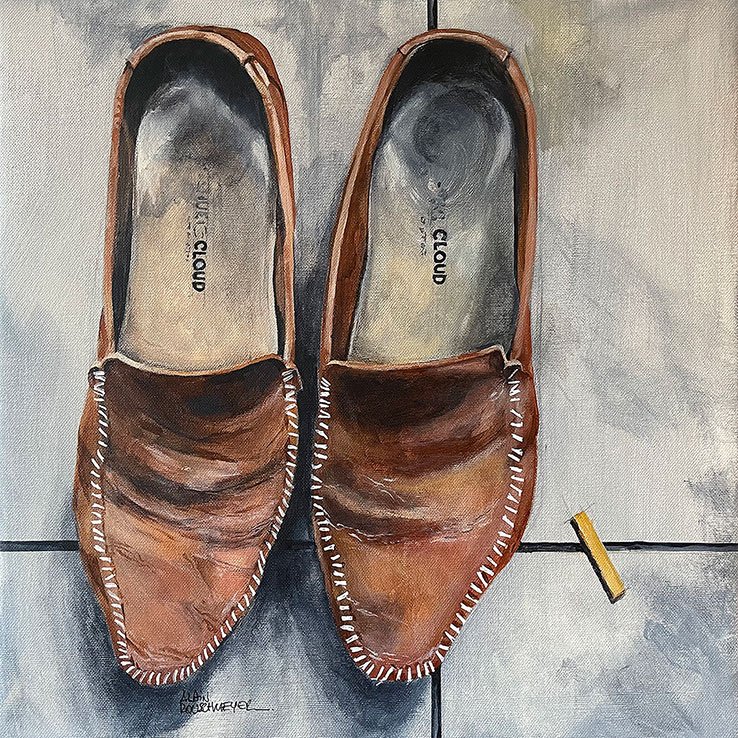
Silent companions of so many walked paths, the shoes lay down their weariness with a weathered elegance.
The creased leather tells tales of miles traveled, of quick or lazy walks, of sunlit halts and shaded crossings.
Beneath their white stitching lies a whole life of footsteps, ready to wander again or savor the suspended moment.
Official Valuation
This artwork benefits from two recognized professional valuations:
View both official valuations
i-CAC: Valuation listed on the official platform for registered professional artists.
Judicial Expert (Pierre Gimenez): Certified appraisal used in legal, tax, and estate contexts.
Technical details
Technique: Acrylic on canvas
Dimensions: 40 x 40 cm
Year: 2025
Support: Canvas on wooden stretcher bars
Framing: unframed (coaching available on request)
Finish: Satin anti-UV varnish
Certificate: Original signed artwork, delivered with certificate of authenticity
Artistic approach
With "CHEMIN FAISANT, MES GROLLES 1", Alain Rouschmeyer captures the quiet soul of everyday objects.
These seemingly simple shoes become silent witnesses of a life journey, carriers of invisible stories and forgotten dust.
The minimalist, almost graphic composition isolates the noble wear of the leather, magnifying this duo resting on the cool tiles, offering the viewer a gentle meditation on the passage of time and the traces left behind
Make an offer
Interested in acquiring this piece?
Click here to make an offer
Each painting finds its place, each encounter its rhythm.
Reproduction available
This artwork is also available as a fine art print (on canvas, paper, aluminium…)
to be informed of the possibilities
Price
Secure payment – Free shipping within France – Careful packaging
Directly from the artist’s studio – Leasing available on request
Shipping & returns
Shipping within 7 to 10 business days
Returns accepted within 14 days (see conditions)
The artwork is insured during transit
Legal notices
Associated Works
The reflection on duration, artistic trajectory and the maturity of the gaze takes concrete form in several contemporary figurative paintings by Alain Rouschmeyer. These works reflect progression. They demonstrate how human posture is situated within a stable and coherent construction. Each composition reveals a stage in this maturation.
The permanence of the body within space, the precision of framing and the balance of lines testify to a gaze shaped over time. These contemporary figurative paintings illustrate the continuity of sustained research. They confirm the relationship between human presence, spatial structure and formal coherence.
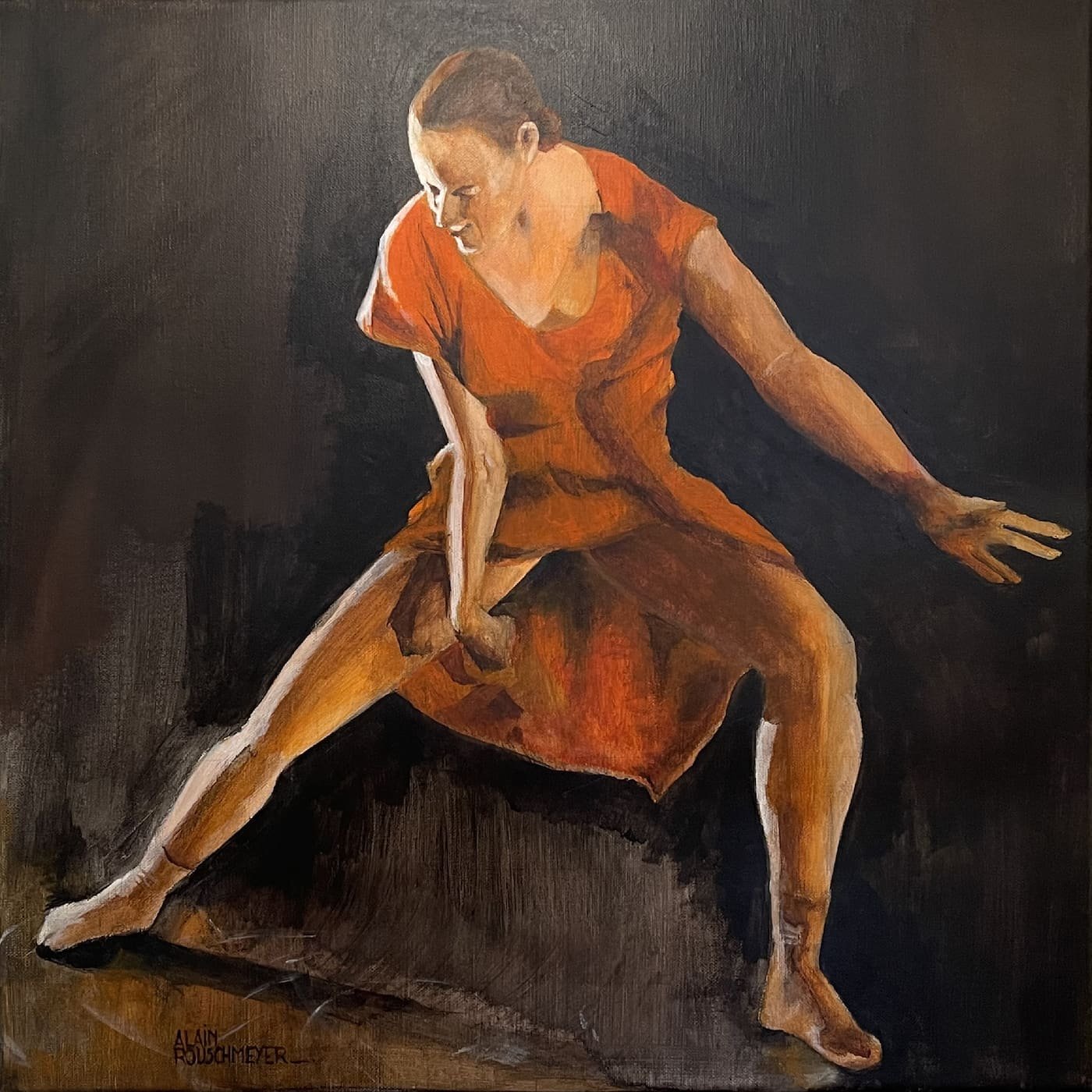
Under the focused light,
she roots herself into the ground like a rising force.
Her body taut, muscles awake,
each movement hugs the earth, seeking inner balance.
Her red dress seems to set the air ablaze,
a fire from within illuminating the shadows.
Official Valuation
This artwork benefits from two recognized professional valuations:
View both official valuations
i-CAC: Valuation listed on the official platform for registered professional artists.
Judicial Expert (Pierre Gimenez): Certified appraisal used in legal, tax, and estate contexts.
Technical details
Technique: Acrylic on canvas
Dimensions: 50 x 50 cm
Year: 2022
Support: Canvas on wooden stretcher bars
Framing: framed in a natural light wood American box frame
Finish: Satin anti-UV varnish
Certificate: Original signed artwork, delivered with certificate of authenticity
Artistic approach
With GROUNDED, I wanted to explore the very essence of contemporary dance:
this earthy energy, this visceral connection between body and ground.
The posture, both tense and fluid, symbolizes raw expression,
a vital impulse contained and released in a single gesture.
Through the vibrant reds and dense blacks,
I sought to make visible this magnificent tension between gravity and flight.
Make an offer
Interested in acquiring this piece?
Click here to make an offer
Each painting finds its place, each encounter its rhythm.
Reproduction available
This artwork is also available as a fine art print (on canvas, paper, aluminium…)
to be informed of the possibilities
Price
Secure payment – Free shipping within France – Careful packaging
Directly from the artist’s studio – Leasing available on request
Shipping & returns
Shipping within 7 to 10 business days
Returns accepted within 14 days (see conditions)
The artwork is insured during transit
Legal notices
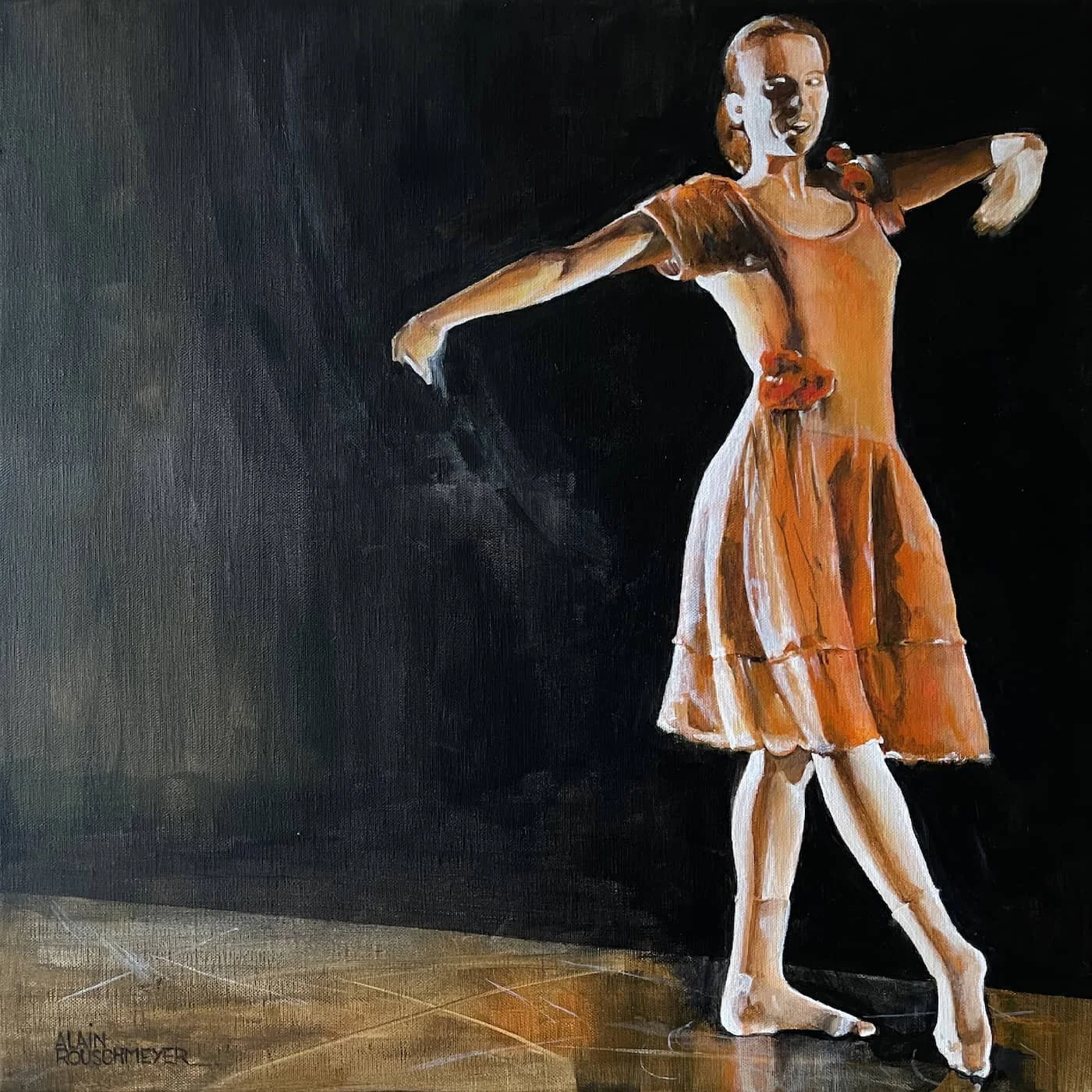
Beneath a golden halo of light,
she rises, both fragile and strong.
Her body opens to the space,
carrying timeless grace in every gesture.
Between shadow and glow, dance becomes a language,
each movement a word suspended in the air.
Official Valuation
This artwork benefits from two recognized professional valuations:
View both official valuations
i-CAC: Valuation listed on the official platform for registered professional artists.
Judicial Expert (Pierre Gimenez): Certified appraisal used in legal, tax, and estate contexts.
Technical details
Technique: Acrylic on canvas
Dimensions: 50 x 50 cm
Year: 2022
Support: Canvas on wooden stretcher bars
Framing: framed in a natural light wood American box frame
Finish: Satin anti-UV varnish
Certificate: Original signed artwork, delivered with certificate of authenticity
Artistic approach
With ALLEGORY, I sought to capture the essence of contemporary dance,
where the body becomes a bearer of profound, wordless emotions.
The chosen posture evokes both lightness and resolve,
a delicate balance between grounding and soaring.
The warm tones of the dress contrast with the darkness of the stage,
highlighting the fleeting, luminous presence of living art.
Make an offer
Interested in acquiring this piece?
Click here to make an offer
Each painting finds its place, each encounter its rhythm.
Reproduction available
This artwork is also available as a fine art print (on canvas, paper, aluminium…)
to be informed of the possibilities
Price
Secure payment – Free shipping within France – Careful packaging
Directly from the artist’s studio – Leasing available on request
Shipping & returns
Shipping within 7 to 10 business days
Returns accepted within 14 days (see conditions)
The artwork is insured during transit
Legal notices

Sur la scène nue,
elle fige le geste ultime d’une chorégraphie intérieure.
Le regard bas, concentré,
la robe effleurant la lumière,
elle ancre dans l’espace l’empreinte d’une émotion brute.
Trois roses abandonnées au sol —
témoins silencieux d’une offrande au mouvement.
Cotation officielle
Cette œuvre bénéficie de deux cotations professionnelles reconnues :
Voir les deux cotations officielles
i-CAC : Cotation référencée sur la plateforme officielle des artistes cotés.
Expert judiciaire (Pierre Gimenez) : Évaluation officielle retenue pour les contextes fiscaux et successoraux.
Détails techniques
Technique : Acrylique sur toile
Dimensions : 50 × 50 cm épaisseur 2 cm
Année : 2022
Support : Toile sur châssis en bois
Encadrement : encadrée
Finitions : Vernis satiné anti-UV - bords peints - prête à être accrochée
Certificat : Œuvre originale signée, livrée avec certificat d’authenticité et certificat de dépôt international
Démarche artistique
Avec POSTURE, j’ai cherché à saisir cet instant rare où le corps, après l'élan, se stabilise,
suspendu entre l’effort et la grâce.
La danse contemporaine devient ici un langage d’intensité contenue,
où la posture finale porte toute l’histoire du mouvement écoulé.
La lumière rasante, les tonalités chaudes, et la discrète présence des roses,
évoquent à la fois la beauté du geste abouti et la fragilité du vivant.
Faire une offre
Intéressé(e) par cette œuvre ?
Cliquer ici pour faire une offre
Chaque toile trouve sa place, chaque rencontre son rythme.
Reproduction disponible
Cette œuvre est également disponible en reproduction d’art (sur toile, papier, aluminium…).
Pour être informé(e) des possibilités, contactez-nous.
Prix
Paiement sécurisé – Livraison gratuite en France – Emballage soigné
Directement depuis l’atelier de l’artiste – Leasing possible sur demande
Livraison & retours
Expédition sous 7 à 10 jours ouvrés
Retours acceptés sous 14 jours (voir conditions)
Œuvre assurée pendant le transport
ADAGP-Paris
Politique de retour – Politique de confidentialité – Conditions d'utilisation
Frequently Asked Questions on Duration in Contemporary Figurative Painting
-
Duration allows a deeper construction of the contemporary figurative painting. It encourages analysis of human posture and mastery of space. Contemporary figurative painting gains coherence through this process. It unfolds within a stable trajectory. It develops a structured gaze rather than relying on immediate effect.
-
Artistic trajectory progressively builds precision of the gaze. Each artwork refines the relationship between body and space. The sketch accompanies this evolution. It clarifies lines and masses. In Alain Rouschmeyer’s contemporary figurative painting, this continuity gives unity to the overall body of work.
-
Human posture situates the body within a defined space. It stabilizes the scene. It allows the viewer to explore composition over time. In contemporary figurative art, the permanence of posture reflects sustained research and constructed maturity.
Explore the Research Axes
This reflection extends across several interconnected sections that structure Alain Rouschmeyer’s contemporary figurative painting. Each page develops a specific axis of research. Together, they articulate a coherent position on human posture, architectural space and duration.
Return to REGARDS
A conceptual overview of the gaze as structural principle in contemporary figurative painting.
Read → Gaze and Architecture
An in-depth analysis of how spatial construction shapes human presence within the composition
Read → Body and Space
A focused study on how posture defines spatial balance and anchors the figure within a constructed environment.
Duration
An exploration of time, slowness and sustained observation in contemporary figurative art.


